HAPPY HALLOWEEN

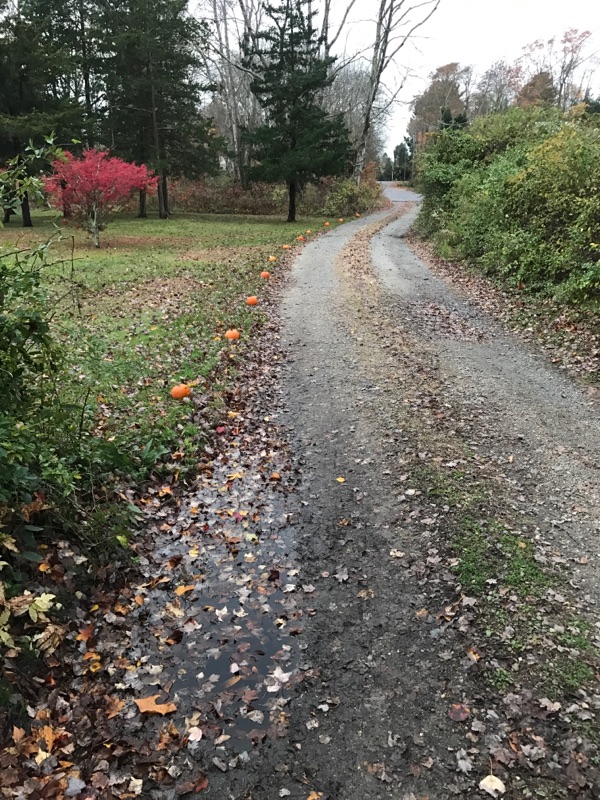
It’s Halloween at Black Hall Bee Farm.  Pumpkins are lit decorations are out and candy is waiting for trick-or-treaters.  PEZ dispensers no less but not a single daring child has  come.  Do you think we could feed PEZ to the bees this winter?

Despite the disappointing turn out for Halloween the bees have had a very productive season.  More than 10 pounds of beautiful golden honey was produced from the wild flowers here at Black Hall Bee Farm.  Antidotal evidence indicates that local honey taken over an

driveway alloween

extended period of time helps relieve seasonal allergies.  Just ask my Mom.  She only uses Black Hall Honey for her seasonal allergy relief.

As the wind begins to calm here by the river there is a happy ending here at the Farm.  A couple of very brave trick-or-treaters have made the trek down the long drive lit by pumpkins to the front porch!  I am so excited that both young ladies are given an entire bag of PEZ!  I wonder if more shall follow.

BEE educated – 2018 Bee Talks.

Beekeeping is an Ever learning process… Go to a Bee School to learn and / or renew what you already know!
Mark your 2018 calendars because the Connecticut Association of Beekeepers was excited to announce a new offering for our members to learn and discuss beekeeping. In addition to our regular meetings and workshops, this new discussion group is your opportunity to engage with knowledgeable and experienced beekeepers to get answers to issues of concern in your beekeeping.

Each session will start with an open question and answer period followed by a seasonally appropriate topic discussion to help guide you through the beekeeping year. Open to every beekeeper regardless of your experience or the type of equipment you use; these sessions will support your beekeeping practice and help you get the critical information you need to be successful.

We have secured a centrally located meeting room at the Rockfall Foundation in Middletown. The meetings will be held on the second Thursday of each month beginning on January 11th at 6:30 pm. and continue through the year. January’s topic discussion will be on the nutritional needs of an overwintering colony and how to formulate a simple but appropriate supplemental food.

The Rockfall Foundation is located at 27 Washington Street in Middletown. The foundation operates in the historic deKoven House where there is ample parking and convenient public lots for additional parking.

The group will be led by Bill Hesbach, the owner of Wing Dance Apiary in Cheshire, who is an EAS Certified Master Beekeeper and a graduate of the University of Montana’s Master Beekeeping Program. Bill is also an author and his writings on beekeeping can be found in Bee Culture magazine. For more information contact Bill at whesbach@me.com or 203-430-2895.

So bring your questions, and we hope to see you there!

Thursday,
January 11, 2018
6:30 pm – 8:00 pm
Rockfall Foundation
27 Washington Street
Middletown, CT 06457

Registration is now open for the Connecticut Association of Beekeepers:

2018 BEEKEEPING SCHOOL

Two dates to choose from (you only have to attend one):
Saturday, January 20, 2018
9:00am to 3:30 pm.
Connecticut Agricultural Experiment Station
123 Huntington Street
New Haven, CT 06511
or
Saturday, February 3, 2018
9:00am to 3:30 pm.
Housatonic Valley Regional High School
246 Warren Turnpike Rd
Falls Village, CT 06031The cost for the bee school is $50 per person and it includes a 2018 membership to the Connecticut Beekeepers Association.

Please register online at ctbees.org/bee-school. Space is limited so register early!

The Beekeeping School is a great opportunity for anyone thinking about the hobby of beekeeping for the first time, or for any beekeepers who might need a useful refresher.

Please pass the word to your friends and neighbors.


Whats in it for me Bee? by Joyce Morgan

Why do we need bees? I mean they sting us, build nests where we don’t see them, (ask the Boy Friend who ran into a hive while mowing the lawn) torment us while camping, (that would be the Yellow Jackets) or just flutter about like the woolly bumble bee.  He doesn’t really do a whole lot either. So with that in mind, why don’t we just get a big ‘ol can of Raid and get rid of them?

Well for one reason, the make up and beauty producers would really get  mad.  Not only would we hurt their bottom line, but where would we get all of those “organic” products from?  Bee products can not be artificially made because bees are unique in what they do.

Bees produce, propolis, (we’ll get to that in a moment), Royal Jelly (when you’re a princess and want to feel like a queen), bees wax (which is highly flammable), bee venom, bread, soap, facial lotions, lip balm, honey, medicinal solutions, all kinds of things. BUT! (yes, there is always a but). The Propolis, which is a by-product of the bee’s saliva and tid bits from trees and plants, is very therapeutic to the hive.  The resinous mixture is used to seal cracks and gaps in the hive which of course protects it from lizards, snakes and whatever else may want to stick its paw in there.  The Egyptians used the Propolis in its mummification process while the Greeks and Assyrians loved it for its healing properties for wounds and even tumors.  Studies have shown that Propolis can help in combating cancer, treats Candida (yeast) Symptoms, stops herpes (cold sores) reproduction, helps to fight off colds and even parasites.

Royal  Jelly, which feeds the next generation of nurse bees and princesses is the “Brain Nourishment”.  You can use it daily to get a motivational boost “the all natural way”.  It has been shown that Royal Jelly helps boost the Immune System, counters allergic reactions, contains beneficial probiotics, eases menopause and post menopausal symptoms, improves collagen levels, and helps healing wounds.  Studies have shown that it MAY also help with osteoporosis and possibly Alzheimers.  I’m sure there are more medicinal uses that we haven’t found yet .


Bee Pollen, which feeds the hive and keeps it running , is a vitamin boost, aids in muscle recovery, energy levels and has lots of proteins, minerals, lipids and fatty acids, enzymes, carotenoids and bioflavonoids. It has powerful antibacterial, antifungal and antiviral properties that strengthen the capillaries, reduce inflammation, stimulate the immune system and lower cholesterol levels naturally.  Known as a “superfood”, bee pollen can be taken daily and mixed with smoothies, yogurt, butter and toast or even Nutella.


Honey, the one thing that Bees are most known for, is rich in vitamins, antioxidants, and magical baking properties.  Honey is also useful in wound care.  In the early days of medicine,  physicians used to mix honey and water to keep wounded men hydrated and to keep them from going into shock.  Oddly enough, we use something similar to cure hangovers today.  Really they could just take a glass of water with honey in it to cure hangovers! Honey is used as an energy boost, sleep aid , hair conditioner and as a facial wash.

Beauty products made from bee products are all over the place in grocery stores and pharmacies.  Lip balms, make-up, facial cleansers, sun tan lotion, hand lotion, you name it, it has a bee on it.

So this is just a short list of what Bees do for us, but what do we do for them? Why should we care about their health and well being? Are they any different from cows, pigs, sheep, goats, and horses? You’ll have to read next weeks blog to find out!


Bee Happy!


Why Bees? by Joyce Morgan

Why Bees? Why indeed? Most people think of the nasty wasps that really play no role in pollination whatsoever, that sting you and it hurts like the dickens!  Not to say that wasps don’t collect pollen in their little “pollen basket”, and studies have shown that even though they are not exactly warm and fuzzy, they do have a hand in pollinating some plants.  Besides, Wasps do eat pollen and nectar.  There are over 140 different species of “Bee Wolves” that hunt our warm and fuzzy friends, the Honey Bees.  The little buggers will go into a honey bee hive, drop off their kids and leave it to the honey bees to feed and care for them until they grow up.

Now, I’m sorry, but if someone dropped off a kid that  wasn’t mine? Don’t you think you’d notice? I don’t know.  That is a question for another day because life in a honey bee hive is rather organized.  Everyone has a job and well, lets face it, if you don’t do it? You’d get kicked out.  No, really seriously. They would boot your butt right out of that hive.

You see, the colony (that’s what its called by the way) houses One Queen Bee, (Not Beyonce) and seasonally a few thousand drones (or fertile males) and tens of thousand of female worker bees.  The women of the hive are not slaves just because they are the worker bees, they are just better at doing their job then the boys. The boys go out and forage for food, while the women of the hive take care of the inner workings.

After the Queen Bee takes her “Mating Flight” (or maiden flight), she hooks up with several different drones from other hives.  She won’t mate with anyone from her hive due to her super powers of “Kin Recognition”. She’ll say. “Whoa Dude! You’re my third cousin on Aunt Hilda’s side.  Sorry.” And leaves him with the bar tab.  Once she returns, she lays her eggs in the honey comb and then decides which ones will be fertilized, and which one will become queen.

Once she chooses her princesses, they will be fed “Royal Jelly” which is produced by the young nurse bees.  The nurse bees care for them until they grow up and hatch into either drones, nurses or a queen bee.  The nurses are just that, nurses.  They clean the hive, care for the young and handle other types of tasks.  Once their royal jelly glands dry up, they transition to foragers where they live out their life flying around collecting food.

Now, the boys, unfortunately, don’t have such a happy ending.  They are collectively evicted come round October.  The nurse bees stop feeding them, they grow weak and then booted out of the hive to be eaten by birds or some other creature.  Over the winter, the hive slows down, feeds on their stores so that the following spring, it starts all over again.

So, the question remains, why bees? What do they do for us that we can’t do for ourselves?  I guess you’ll have to read the next article to find out.  Thanks for reading!