Blog, blog, blog away

HAPPY HALLOWEEN

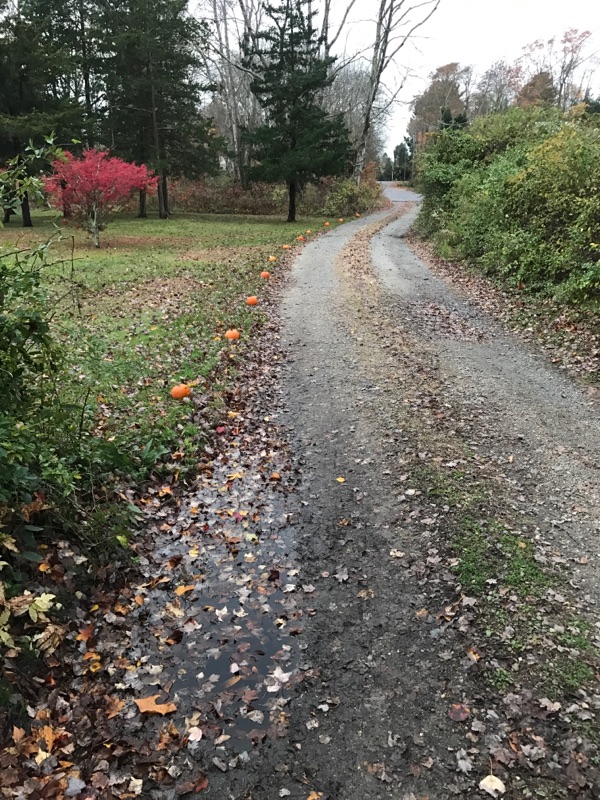
It’s Halloween at Black Hall Bee Farm.  Pumpkins are lit decorations are out and candy is waiting for trick-or-treaters.  PEZ dispensers no less but not a single daring child has  come.  Do you think we could feed PEZ to the bees this winter?

Despite the disappointing turn out for Halloween the bees have had a very productive season.  More than 10 pounds of beautiful golden honey was produced from the wild flowers here at Black Hall Bee Farm.  Antidotal evidence indicates that local honey taken over an

driveway alloween

extended period of time helps relieve seasonal allergies.  Just ask my Mom.  She only uses Black Hall Honey for her seasonal allergy relief.

As the wind begins to calm here by the river there is a happy ending here at the Farm.  A couple of very brave trick-or-treaters have made the trek down the long drive lit by pumpkins to the front porch!  I am so excited that both young ladies are given an entire bag of PEZ!  I wonder if more shall follow.

Bee an Athlete!


Watching the winter Olympics always awakens the crazy athlete in all of us.  My daughter decided she could be a figure skater.  Everyone who sweeps the floor was suddenly an Olympic curler.  I’ve always loved the downhill skiing myself, reminds me of racing through the woods on horseback jumping obstacles, much like weaving in and around the poles on the downhill; controlling your speed at the risk of losing a medal, the risk of wiping out and getting hurt.

So how does honey help these Olympic athletes? During training, on an average day, an Olympic athlete in training will burn anywhere between 4,000 to 6,000 calories per day.  Consequently, they need to replenish those calories  and they need to maintain a balance between carbohydrates and protein.

Before competitions, and during training, some athletes would take honey to boost their blood sugar when they started to feel weak and shaky.  Kerry Walsh Jennings, an indoor and beach volleyball gold medalist, includes almond butter and honey sandwiches before competitions to give her energy.

But this is not new information. The Olympics originated in Olympia Greece back in 776 B.C., the ancient athletes used honey as an energy source, and the ancients knew that honey would help them achieve their fullest potential.

Recent studies show that honey is an excellent fuel source and can help Olympic athletes win gold. During clinical trials by the United States Honey Board proved that honey is an excellent fuel source for athletes and can boost athletic performance.  The results were clear that the honey balanced out blood sugars and was an effective pre-workout energy sources.  In another study, it showed that athletes who consumed honey sweetened shakes were able to sustain blood sugar levels for two hours after exercise.

Bee an Olympian! Go for the gold!


Scars, Beeware! by Joyce Morgan

I feel bad for Carrie Underwood. I do.  I know,  I know, why feel bad for someone who is beautiful, talented, and married to a hunky NHL star? Whose first CD sold better than my first novel of the same name?  When Jesus took the wheel, he drove over my book, and that is a person I should feel bad for?  Well yes, I do, because she is a kind, good person with a strong faith in family and God; and she took a digger down her front walk way, broke her wrist and cut open her face.  Said injury required 50 to 60 stitches.  I’m sure she had the best plastic surgeon in Nashville, but still, her face is her brand and I know she is probably feeling really insecure about it right now.  Hell, I would.

But dearest Carrie, have you tried honey to help reduce scarring and help with healing?  Honey is a natural moisturizer and is effective in the healing of wounds and the reduction of scars.   Manuka honey was approved by the FDA for the treatment of open wounds.  One of the biggest antiseptic features of this honey is  its ability to release hydrogen peroxide that helps to eliminate bacterial activity.  Our fuzzy little friends collects the pollen from a Manuka bush and they work to turn it into honey.  This honey is used to treat burned skin, rashes and even boils.  According to “Heart Views”, the journal of Gulf Heart Association, honey stimulates the healing process. Make sure that if you’re going to try and use honey for the treatment of wounds, you don’t use store bought as it has a high level of corn syrup which would spread the infection.  You should  also always consult with your physician for personalized advice.
My daughter always watches these beauty blogs and the bloggers always make it look so easy. Those fruit, oatmeal, salt and oil masks look easy to make, but  are quite frankly, are rather messy to make. But using raw honey is great for your skin and has loads of vitamins B2, B3 and B5 as well as minerals. Just a thin coat of honey mixed with a little baking soda and you have a perfect mix for a DIY exfoliante.
So, while our little friends work busily creating their magic nectar, we continue to find other useful and wonderful uses for their gifts.  I do hope that Carrie’s wounds heal and she once again graces us with her amazing voice.   It is also my wish, that she realizes that she is loved for who she is, and all that she has to offer.


Bee Happy!

Bee-Aware by Joyce Morgan

Part of our responsibilities as stewards of animals is to always make sure that they are well cared for, kept healthy and safe.  Just recently over 50 horses died due to tainted grain.  The feed maker sells to Cows, sheep, goats and horse owners.  The supplement, Monesin, was added to the grain.  While harmless to cows, it is deadly to horses, even in a small trace amounts.  Usually after doing a run of grain, the manufacturers will run flour or something else through the machines to clean out the toxin before running horse feed.  In this particular case, it wasn’t cleaned properly.  The grain that went through the machine was intended for horses, and  it killed them.

The next question you’re going to ask is, what does this have to do with bees? In the winter, (especially on this blizzardy day) bee farmers supplement their hives with honey.  Store bought honey, “organic” honey, honey from neighboring farms and the like.  But like our tainted grain, getting honey from other sources may also contain bacteria, and this bacteria can kill your bees.

Since the USDA has classified Bees as livestock, making them fall under the purview of Veterinarians, Bee farmers should insure their bees.  In the case of the horses, the farm owner is the only one who can sue the manufacturer.  Horses are considered chattel and therefore the owners are ineligible to join a class action suit against grain producers. Meaning, that if their horses are Grand Prix Jumpers, hunters, race horses, even down to a child’s pony; the owners have no recourse against the manufacturer.  These horses cost a lot of money, especially if they were earning money, without insurance, the owners are left horseless and broke.  If the Bee owners purchase tainted honey causing their hives to contract American Foul Brood, they are left broke and Bee-less.

American Foul Brood is caused by spores in filler honey.  These spores can not be killed by regular pasteurization, or heating methods, and well meaning people, set out this honey, where our Bee friends collect it to feed the hive.  Since the hives can NOT be opened during the winter, there is no way that the Bee farmers will find out that their hives are sick.  They can not call a veterinarian to treat the hives, or to stop the inevitable death of their hives.   According to studies, AFB is more common than originally thought.  The decline of wild and managed honey bee colonies have been linked to the introduction of pests, diseases, exposure to pesticides, and stress, (yes bees can get stressed).

So I suppose the biggest question is, what does this have to do with poisoned horses, sick hives and the deaths of colonies?  Money.  Bees are considered livestock, responsible for the pollination of over 100 different commercially grown crops. Recently, in Sioux City, Iowa, over 500,000 bees died due to vandals knocking over 50 hives.  The damaged hives lost the farmer anywhere between $50,000.00 to $60,000.00 dollars. If the Bees die due to outside factors, sickness, vandalism whatever, the Bee farmers lose a considerable amount of money.  Without insuring the livestock, the farmer has no way to recoup the funds spent on building hives, herds or replacing crops.

The American Bee Keeping Federation offers several types of policies covering the usual, homeowners, Farm, livestock, and automobile.  The Bee farmer should investigate insuring their hives to protect their interests.  Small Bee farmers obviously may not be able to afford the insurance, but protecting yourselves and your Bees is part of our jobs as stewards of our furry friends.

It is sad to think that the joy of farming comes down to money. If your hives get sick, and over 50% of them die, there goes more than 50% of your profits. Where does the local farmer get the money to replace the bees that they’ve lost?  Insurance, unfortunately.  It is one of those things that cover the “What If”.

So, Bee-Aware of the What ifs in life, it may save your Bees in the long run.


Bee Warm by Joyce Morgan

I’m toasty warm, sipping a cup of tea and wrapping gifts, watching the snow drift down. You can look out across the fields with the blowing snow and see the white boxes nestled in snow drifts. While its very pretty to look at, it can be gosh darn cold.   I’ve always wondered how our fuzzy little friends stay warm since they kicked out all the dudes.  That leaves our girls hanging out with the Queen.

A healthy hive will form a hoard, cluster, ball of bees.  The bees will cover a number of frames and usually in the vertical center of the hive.  The size of the hoard depends on the size of the hive and how strong it is.  Smaller hives usually won’t make it through the winter because they can’t afford to move to eat.

An outer shell of bees line up side-by-side, facing into the hoard to create a thermal barrier. At this point, the body heat of the outer layer of bees supplies enough warmth to maintain the bees inside the hoard.  This outer layer of bees can be one bee-layer thick, or can build up to a number of bee-layers in thickness.

The bees on the inside can still walk around over the comb and sometimes eat a little honey.  Periodically bees switch places, with ones from the inner core taking up a position on the outer core to allow the outer bees to go “inside”.

In order to produce body heat and stay alive, honeybees must rely on honey for energy. Some studies have found that hives of honeybees will consume up to 30 pounds of stored honey over the course of a single winter time, (October through February).

As supplies dwindle where the cluster has formed, the bees will move up.  They seldom move to the sides.  After all, going up between the frames is far less work than moving the ball of bees around all the frames.

Temperature is a key factor.   The colder it is the tighter the hoard.   They start to hoard around 60 degrees .  That is the day time temperature in October, and it creeps up to that in March.  By April, they start to go out and forage.  Over  the winter, they are not totally housebound, they do go out and spread their wings, use the facilities, and then they scoot back inside where its warm.

I find it really fascinating of how they winter, I mean you can’t very well open the hive to check on everyone you’d let out all of the heat they have generated, maybe one of those spy cameras could be inserted into the hive to see what is going on.

So, while our fuzzy friends bundle up to keep warm, let’s wish them all a Merry Christmas.


Bee Warm!